


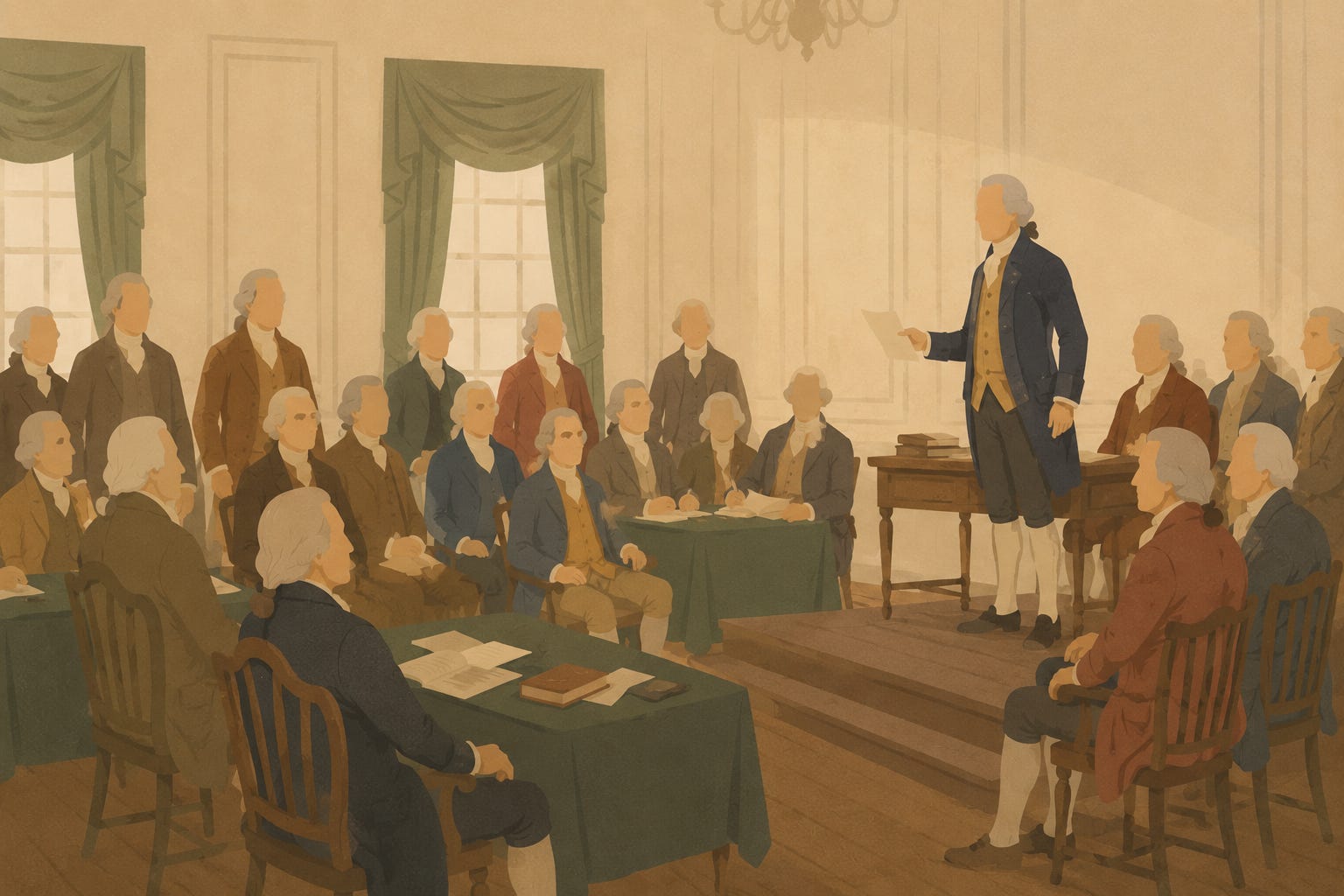
I have been reading a lot of history in the lead-up to this year’s Big Celebration—250 years since our initial Declaration of Independence from Britain. America has been called by many an “experiment,” one whose governing principles owe a debt of gratitude to the Enlightened minds of Locke, Kant, and Smith, among others. These principles champion self-reliance, self-sufficiency, and the freedom to think, live, and act as an individual, with the power and ability to contribute to the country one calls home.
For so long, Europe had been hamstrung by traditions and hierarchy, with ruling classes unwilling to change and adapt, knowing full well that the philosophical grounds on which they once walked were already sparking revolt across the Ocean. Back in 1775, the American Revolution came as a surprise to some. Yet another came with its victory, and still, the ongoing surprise with each passing decade, as the world looked on to see the United States continuing to function, as well as, from time to time, deciding to change its course, using its greatest power—amending itself.
Now, I say the word “amend” looking directly at our governing document’s twenty-seven changes, from rights of due process (Amendment Five) to congressional pay raises (Amendment Twenty-Seven). Within the list of changes rests the story of America—a clouded and dark history. Without the ability to amend, I firmly believe the Declaration stood for nothing. Without the ability to amend, our country would not have lasted.
. . .
Now, Noah, what’s the big deal about an amendment? Aren’t all passed laws a bit of an about-face? Given that new statutes bring about adjustments or additions to the existing code, there is a great amount of truth resting on such a claim. It’s worth noting that a consequential piece of legislation like the “Civil Rights Act of 1965” was not unanimous at its time and was quite controversial in the South, overcoming a famous 74-day filibuster by Southern Democrats, but altogether brought a legislative end to Jim Crow, segregation, and discrimination in public places by way of a statute, not a constitutional amendment.
What separates a law from a constitutional amendment? From my perspective, it requires the greatest amount of recompense and understanding from start to finish. A proposal requires approval by two-thirds of Congress, and ratification requires sign-off from three-fourths of state legislatures. Translation: lots of folks gotta get on board.
. . .
Chief among our amendments was the abolition of slavery found in the Thirteenth Amendment, stating in section one, “Neither slavery nor involuntary servitude, except as a punishment for crime whereof the party shall have been duly convicted, shall exist within the United States, or any place subject to their jurisdiction.”
Abolishing slavery was something Europe beat America to the punch—a clear sign of both the work of churchmen like William Wilberforce and the staying power of Enlightenment principles in the halls of government across the world. America, however, was willing to let the practice continue, making the Declaration’s initial claims of “all men are created equal” sound less and less true by the day.
At our nation’s founding, the presence of many enslaved peoples proved that our founders failed to grasp the imago dei resting in the hearts and minds of all people on our shores. Enslaving people allowed owners free rein to r*pe and murder to their liking without facing any repercussions. Fathers and sons were worked to death or sent away at a price. Mothers and daughters had dueling loyalties to the rooms of their betrothed and the master over them. Millions died, named and unnamed, in the wake, leaving a heavy cloud over us all, with no amount of forgiveness apart from God being good enough to remove the generations of scars.
In my younger years, I believed that, despite our history, America was innately good and possessed a power no other land could match, because I held dear that we were a Christian nation. We’ve won wars and become friends with all. Our economic strength, felt both at home and abroad, has earned us the top spot on the global stage. We were good because we are the best.
My thoughts and feelings contain far more gray and nuance today. History is written by the victors, yes, and over the last 250 years, we have won a lot, but despite our victories, many perspectives and voices have been left without a microphone.
And yet, therein lies our strength—we have looked at our wrongs and decided to change course. We amended. We waged war for the sake of amending. Over the course of a war fought over slavery, 750,000 lives were lost, and we still chose to amend.
. . .
I believe America is positioned well, given our well-documented history, including both our rights and wrongs. The stains of our past, however, do not mark the founding in vain. The American Revolution, which toppled a perceived global power, sparked hope that self-government is not only possible but worth striving for, lighting similar fires around the world.
“America is not great because it is good; flaws abound, but it is great because it is better than before and better than the beginning, a more perfect union.”
As we fought to amend over the last 250 years, the debts will never be paid in full, but we can stand to celebrate this country, not because it is perfect, but because it is better than before. The principles captured at the founding have been interpreted and expounded, allowing this nation to be born, nurtured, and grown into the land we have today. Our decision to govern in this way, by the people, might have been novel for its time, but it remains, in my mind, the best. Why? It has given the people, our people, Americans of all kinds, space to amend.
America is not great because it is good; flaws abound, but it is great because it is better than before and far better than the beginning, a more perfect union. When we amend, we admit our past wrongs. When we amend, we allow for new opportunities and perspectives, new voices to speak into the history we have often claimed as victors. When we amend, it sparks hope for future generations that we can chart a course the Founders might not have considered, capturing the essence and the envy that instilled in us the confidence to begin the experiment that continues 250 years later.
My fellow Americans, may this be a time when we give thanks not only to the founders of this nation, but also to the many American heroes who led the revolutions that helped us acknowledge wrongdoing and amend our past, opening doors of opportunity toward a brighter future for all Americans.
For the two-hundred-and-fiftieth time, Happy Fourth.